

Occupational Therapy
As an allied health profession, Occupational Therapy looks beyond diagnosis to understand the whole person. We explore how physical and mental health, thinking and processing skills, sensory needs, and everyday environments can affect an individual’s ability to participate in the activities that matter most to them.
Occupational Therapy at Leeds Conservatoire
At Leeds Conservatoire, our Occupational Therapists (OTs) provide one-to-one support and specialist assessments to help you navigate any difficulties that may be affecting your ability to thrive during your time with us.
We focus on enhancing your independence, wellbeing, creativity and academic engagement by working with you to address any physical, emotional, cognitive or sensory barriers that may be impacting your participation in student life.
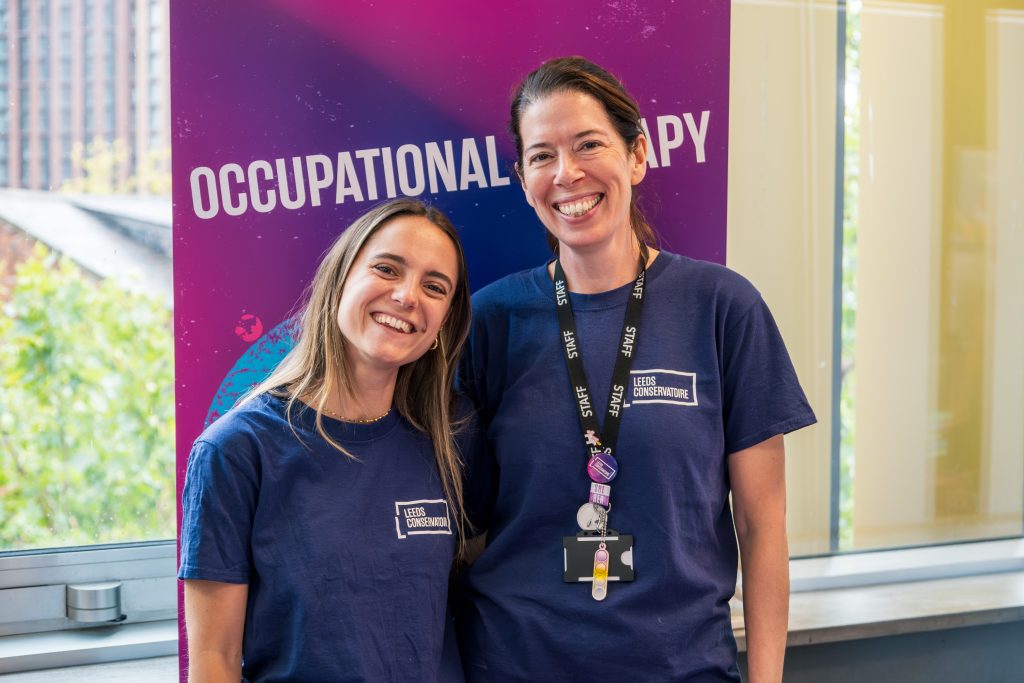
What is Occupational Therapy?
Occupational Therapy (OT) is a client-centred health profession that supports your wellbeing by helping you to engage with ‘daily occupations’ – the things you need and want to do as a student. These include everything from studying and managing your routine to socialising and self-care.
Occupational Therapists take a holistic approach, meaning they look at all aspects of your life, including your mental wellbeing, cognitive functioning, physical health, and sensory needs. They work with individuals to tackle challenges that may make it difficult to do the things you want or need to do, such as managing personal care, studying, working, or engaging in meaningful hobbies. The goal of occupational therapy is to help people live their best lives, no matter what challenges they may face.
Occupational Therapy Can Help You With:
Occupational Therapy can help if physical, sensory, cognitive, emotional, or practical challenges are making it harder for you to take part in your studies, creative practice, daily activities, or university life.
We work with you to understand how these challenges affect the things you need and want to do. Together, we identify meaningful goals and develop practical strategies, adaptations, and routines to support your participation, independence, and wellbeing.
- Developing routines and balancing the demands of university, work, creative practice, and daily life
- Tackling cognitive issues such as difficulty with; concentration, memory, organisation, planning, and managing academic tasks
- Managing stress, overwhelm, fatigue or burnout
- Understanding and managing sensory differences, including sensory overload
- Pain, physical health conditions, or physical difficulties that affect day-to-day activities
- Building confidence in social situations, group work, collaboration, and relationships
- Understanding how a health condition, disability, or neurodivergence affects your ability to study, create, work, and manage everyday activities, and identifying strategies that work for you
- Developing habits, routines, and coping strategies that support your goals
Where appropriate, we can also provide specialist assessments, recommendations, and referrals to other services.
Our aim is to help you participate more fully in your studies, creative work, and the activities that are important to you.
To note, Occupational Therapy is not counselling or what you might consider as ‘therapy’. Our aim is to work with you in a practical way to help you function and thrive whilst at university.
Our Approach
We understand that factors like mental health, neurodivergence, and life transitions can impact your day-to-day experience.
Whether you’re adjusting to university life, managing your health, or looking to build habits and routines, OT can help you develop strategies to feel more confident and capable both during your time at the conservatoire and beyond.
Access Occupational Therapy
To access support, you need to complete a short online referral form. Once we receive your form, we will match you with an appropriate member of our team. They will contact you via email with an invitation to an initial meeting.
Outside of term-time, we operate a reduced service for postgraduate students and those resitting assessments.
If you have any other questions or need support that isn’t covered by the referral form, please get in touch with us.
Frequently Asked Questions (FAQs)
Who can access support?
All Leeds Conservatoire students can access occupational therapy support once enrolled. We are open to everybody and students who have previously accessed support are welcome to re-refer at any time during their studies.
How can I access support?
To access support, you need to complete a short online referral form.
Once we receive your form, we will match you with an appropriate member of our team. They will contact you via email with an invitation to an Initial appointment.
Please note: Our referral form closes during the Christmas, Easter, and summer holidays. During the summer holiday, we operate a reduced service for postgraduate students and those resitting assessments. For more information about support outside of term-time, please email us occupationaltherapy@leedsconservatoire.ac.uk
If you’re in need of urgent support, please refer to the Urgent Support (SOS) page.
Is there a waiting list?
We don’t have a waiting list and will aim to offer you an initial appointment as soon as possible after receiving your referral form. In most cases, this will be within a few working days.
The time between appointments can vary depending on your individual needs, staff availability, and demand for the service. There may be longer gaps between appointments during busy periods.
If there are likely to be significant delays, we will do our best to keep you informed and discuss any available options with you.
Appointments and Meetings
Who will I meet with?
You will be supported by a member of the Occupational Therapy team. This may be one of our Occupational Therapists or an Occupational Therapy student on clinical placement, working under the supervision of a qualified Occupational Therapist.
Where possible, you will usually meet with the same team member, helping to provide consistency and continuity of support.
Occasionally, it may be helpful for you to work with a different member of the team. This could be to access a particular area of expertise, support your goals more effectively, or accommodate changes within the service.
How many appointments will I have?
In our Occupational Therapy service, we offer short term support, but this is tailored to your individual needs, goals, and circumstances.
During your initial appointment, we will work together to understand the challenges you are experiencing, identify what is important to you, and agree on goals for our work together. The focus and length of support will depend on your needs and the progress you are making towards your goals.
We will regularly review your progress and discuss next steps with you. When we agree that Occupational Therapy is no longer required our support will come to an end. Where appropriate, we may discuss other sources of support or options available to you.
Where do appointments take place?
We hold appointments in person and online via Microsoft Teams. You can indicate your appointment preference in the referral form, and we will try our best to accommodate it.
In-person appointments are held in the St Peter’s Square building on the fourth floor.
Do I need to prepare anything?
No. Just bring yourself and be ready to talk about your difficulties.
Please be aware that as we do not have a waiting room and space outside our meeting rooms is limited, it’s best not to arrive too early for your appointment.
Can I bring somebody with me?
To respect your confidentiality and privacy, we ask that you attend appointments alone. This also applies to online appointments.
If for any reason, you require someone to support you, please email us prior to your appointment on:
occuationaltherapy@leedsconservatoire.ac.uk
Confidentiality and Attendance
Is the service confidential?
Yes. Everything you tell us will remain confidential, unless we believe that you are at risk of harm, or that you pose a risk of harm to somebody else.
In line with our professional standards of practice, our team regularly undergoes professional clinical supervision, during which we discuss the students we are supporting. These discussions adhere to the same confidentiality conditions detailed above.
We will never speak to parents, guardians, family members, or friends about your access to the service without your explicit consent. Similarly, we will not share any details about other students accessing the service with you.
Occasionally, we may share limited information with the Disability Support team to coordinate support (e.g. declared disabilities, access to the service). Sometimes, it may be appropriate to pass your details on to another staff member or external service (e.g. a support charity or NHS service). In normal circumstances, we will always seek your consent before doing so.
What happens if I’m running late?
If you are running late for any reason, please let us know as soon as possible by emailing occupationaltherapy@leedsconservatoire.ac.uk. We will advise on the best course of action depending on the length of the delay.
If we do not hear from you, we will wait for 15 minutes after the scheduled start time. If you have not arrived within this time, the appointment will be cancelled and recorded as a ‘no-show’. Following a no-show, we will contact you by email to ask whether you would like to rearrange your appointment. If we do not receive a response within 5 working days, your Occupational Therapy support will end and we will stop contacting you to arrange appointments.
If your Occupational Therapy support has ended and you would like to access the service again in the future, you are welcome to submit a new referral form.
What if I can’t make my appointment?
If you can’t make your appointment, let us know as soon as possible by emailing: occupationaltherapy@leedsconservatoire.ac.uk. We will cancel your appointment and help you to reschedule.
Due to high demand for the service, if you cancel three appointments in a row without a valid reason, our support will come to an end. If you would like Occupational Therapy support again during your studies, you are welcome to submit a new referral form.
What happens when my Occupational Therapy support comes to an end?
At the end of our work together, we hope that you will feel equipped with the tools and techniques to manage challenges independently and participate in the activities that are important to you.
In your final session, we will review the progress you have made and discuss any next steps or ongoing support that may be helpful.
When our support comes to an end, we will no longer contact you to arrange appointments. This does not prevent you from accessing Occupational Therapy support again in the future. If you would like further support during your studies, you can submit a new referral form and we will consider how we may be able to help.
Sometimes our support may end earlier if we are unable to maintain contact with you. This may happen if:
- You do not attend an appointment and we are unable to re-establish contact.
- You miss two appointments in a row without letting us know.
- You cancel three appointments in a row without a valid reason.
If this happens, you are welcome to re-refer to the service at a later date if you would like support.
Support for Others and Accessibility
I’m worried about a friend, what can I do?
If you are worried about a friend and think they would benefit from our support, there are several actions
you can take:
- Talk to them: Share your concern and let them know that our team can help. Direct them to either the Health and Wellbeing or Occupational Therapy page on the Student Info site and direct them to the referral form if they wish to seek support.
- Encourage them to email us: This allows them to explain their difficulties in their own words and seek support on their own terms.
- Talk to us: If you think a friend would benefit from our support but may be hesitant to reach out, send an email to: OccupationalTherapy@leedsconservatoire.ac.uk . When emailing, please:
- Include your friend’s full name, course, and year of study (if known)
- Provide a brief description of their current difficulties
Where possible, tell your friend that you are contacting us about them. When we reach out to offer support we will usually tell them that someone has raised concerns.
If your friend needs urgent support, follow the guidance on the Urgent Support (SOS) page.
Do you offer a drop-in service?
Due to the nature of our service, we cannot offer drop-in appointments.
Short notice appointments with the Health and Wellbeing Team can be booked via email healthandwellbeing@leedsconservatoire.ac.uk
Academic and Long-Term Support
Can you provide Additional Consideration for an exam or assessment?
No, the Occupational Therapy team are not involved with Additional Consideration applications. It is the Exams team who process the applications and make the final decision. We can however support you with the issues that are causing you to apply for Additional Consideration in the first place.
For more information, visit the Exam and Assessment Support Space page or email exams@lcm.ac.uk
Contact and Data
How is my data stored and used?
Your data will be generally collected and used in accordance with the Leeds Conservatoire HE Student Privacy Notice. This will include the personal data that you provide to us in the Student Support Referral Form, any subsequent forms and appointment notes made by our team.
After every appointment, we make short written notes to record progress, document important information, and describe any interventions. These notes are stored in a secure digital system and can only be accessed by relevant Student Support staff. Handwritten notes are disposed of and destroyed as confidential waste. In normal circumstances, appointment notes will not be shared without your consent.
All records are used for the purpose of providing support and information will be held securely on Leeds Conservatoire-approved drives for 7 years from the date that you leave Leeds Conservatoire. We also produce anonymised statistical data for the purposes of service analysis and development.
How can I contact you?
You can email us at: occupationaltherapy@leedsconservatoire.ac.uk
Make sure to contact us from your Leeds Conservatoire student email address, for security purposes we cannot respond to emails from personal accounts.